Breach response
What a Leaked Password Actually Costs You
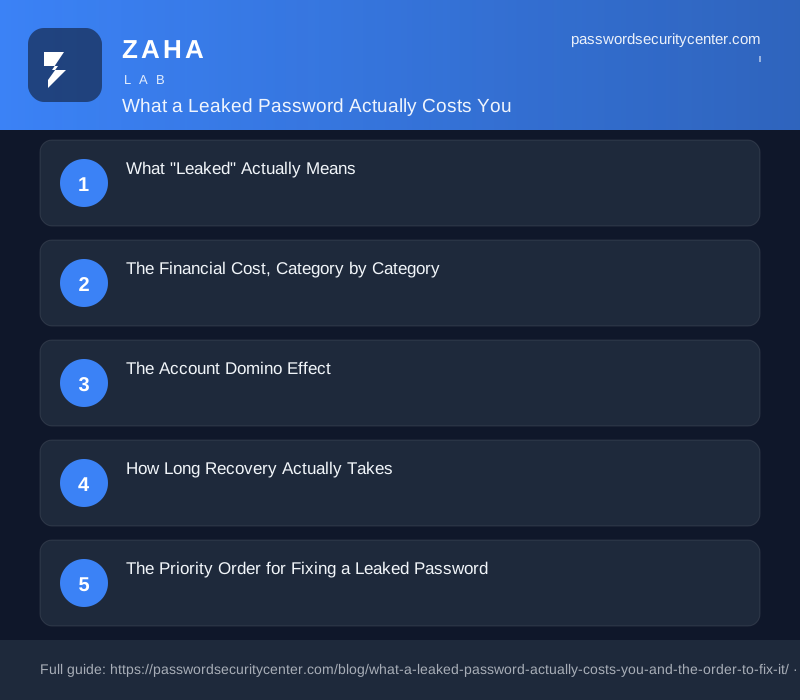
A leaked password is not just one account problem. Every service sharing that credential is exposed simultaneously, and the real costs include unauthorized charges, potential tax fraud, and roughly 7 to 15 hours of your own time on recovery. Securing your email first, then financial accounts, then work accounts is the order that limits damage most efficiently.

Over a billion unique passwords are now indexed in freely searchable breach databases. If you have reused a password anywhere, one credential check can expose every account sharing it.
A leaked password is not just one account problem. The financial damage, time cost, and cascading access risk stack quickly. Here is what happens after a credential leaks, what each consequence costs, and the order to fix it.
What "Leaked" Actually Means
"Leaked" covers two separate events, and both matter.
The first is the breach itself. A site you use stores your password in a database. Attackers extract that database. If the site hashed passwords poorly, using MD5 or unsalted SHA-1, cracking hardware can reverse the hash to plaintext within hours. If the site stored passwords without any hashing at all, attackers read your credentials immediately.
The second event is distribution. Credential dumps circulate on private forums and closed markets within days of a breach. By the time you receive a breach notification email, your credentials may already be in multiple hands.
Automated tools then take over. A technique called credential stuffing, documented by MITRE ATT&CK as T1110.003, takes stolen username and password pairs and tests them against hundreds of sites at scale. It requires no hacking skill. Success rates per attempt are low, typically 0.1 to 2 percent, but attackers work from dumps containing millions of records. The numbers favor them.
The gap between a breach occurring and you receiving a notification has historically stretched into months. Many victims only learn about a compromise after spotting suspicious charges or being locked out of their own account.
You can check whether your email address or a specific password has appeared in a known breach at Have I Been Pwned, which indexes hundreds of millions of unique compromised passwords across thousands of documented breaches.
The Financial Cost, Category by Category
The damage is rarely a single line on a bank statement. It compounds across several different channels.
Direct theft from financial accounts. An attacker inside your bank or brokerage can initiate wire transfers, apply for credit increases, or open new lines of credit in your name. Some losses are recoverable through fraud protections, but the dispute process takes days to weeks and does not always succeed in full.
Tax refund fraud. With enough personal data collected from linked accounts, an attacker can file a tax return in your name before you do. The IRS processes the fraudulent refund first. You then file a paper return, prove your identity, and wait through a review process that typically takes 6 to 9 months.
Payroll and employment fraud. A breached work email or HR portal credential lets attackers redirect your payroll deposit, access company financial records, or impersonate you in fraud schemes targeting your colleagues or clients.
Charges from stored payment methods. Accounts with saved cards, including Amazon, Apple, Google Pay, and PayPal, can generate fraudulent charges that are easy to miss on a busy statement for weeks.
| Cost Category | Who Bears It | Typical Recovery Path |
|---|---|---|
| Unauthorized bank transfer | You, unless fraud protections apply | Bank dispute, 1-10 business days |
| New fraudulent credit line | You (credit score damage, then disputes) | FTC report, credit bureau disputes |
| Payroll redirect | You or employer | HR investigation, payroll correction |
| Tax refund fraud | You (delayed refund) | IRS Form 14039, 6 to 9 months |
| Business email compromise | Your employer | Incident response, legal review |
The FTC notes that identity theft recovery involves significant non-financial costs. Filing reports, making calls to fraud departments, and working through bureau dispute processes together take most people between 7 and 15 hours, spread across several weeks.
The Account Domino Effect
Password reuse is the multiplier that turns one breach into many.
Your email address is the master key to every other service you use. Password reset links land in your inbox. An attacker who controls your email can reset your bank, social media, and work accounts even if those accounts use strong, unique passwords. Getting into email is the first objective for most automated attack chains, because it opens everything downstream.
After email, attackers prioritize accounts with stored payment methods: Amazon, PayPal, Apple ID, and Google Account. From a compromised Google Account, an attacker can access Gmail, Google Drive, Google Pay, and any third-party service using "Sign in with Google." One credential, four or more simultaneous access points.
If your email password was leaked, every other account is at risk. Attackers can reset passwords for services that use strong, unique credentials just by controlling your inbox. Secure your email before anything else.
Work accounts carry a separate category of risk. A breached VPN credential or work email can expose company intellectual property, customer records, and financial data. Depending on your employment contract and jurisdiction, personal liability can follow if the breach affects your employer or its clients.
How Long Recovery Actually Takes
Most people underestimate the timeline.
Detection alone takes time. The Verizon Data Breach Investigations Report documents year after year that attackers operate inside compromised accounts for extended periods before victims notice. Personal accounts are the most exposed: there is no IT team watching for unusual login patterns.
Once you detect the problem, formal processes are slow. Under US Regulation E, your bank has 1 to 10 business days for initial resolution of a debit fraud dispute, and up to 90 days for complex investigations. Credit card disputes under the Fair Credit Billing Act give you 60 days to report, but resolution can extend beyond that.
Credit report damage runs on a separate track. A fraudulent account on your report requires a dispute filed individually with Equifax, Experian, and TransUnion. Each bureau has up to 30 days to investigate. A credit freeze stops new fraudulent accounts from opening but does not remove items already listed.
The hours pile up: each call to a fraud department, each identity verification form, each follow-up letter to a bureau. The emotional cost of explaining the same incident from scratch to different agents is harder to quantify but very real.
The Priority Order for Fixing a Leaked Password
Not all accounts need fixing at the same speed. Here is the order that contains damage most efficiently.
Step 1: Email accounts (immediate)
Change the password on your primary email account first, to something long, random, and unique to that account. Then enable two-factor authentication. NIST SP 800-63B recommends authenticator apps and hardware security keys over SMS codes, because SIM-swapping attacks can intercept SMS 2FA. If you have multiple email addresses, secure all of them.
Step 2: Financial accounts (within the hour)
Banks, credit unions, brokerage platforms, and payment services. Change passwords, enable 2FA on each, and review recent transactions. Set up real-time transaction alerts if your provider offers them. Call the fraud line directly if anything looks unauthorized.
Step 3: Work accounts (within 24 hours)
Report the suspected breach to your IT or security team before attempting to fix the account yourself. Work credentials carry compliance obligations that personal accounts do not. Your security team needs to audit access logs and determine whether any internal systems were affected.
Step 4: Every account sharing the leaked password
Change every other account using the same password. A password manager makes this tractable: generate a 16-character or longer random password for each site, store it, and stop reusing. Have I Been Pwned's Pwned Passwords tool lets you check whether a specific password has appeared in known dumps before you reuse it elsewhere.
Changing 20 passwords by hand means 20 browser tabs and 20 reset emails. A password manager generates and stores a unique credential for each site. The total work drops to one strong master password and a few minutes of setup.
Step 5: Upgrade your second factor going forward
Authenticator apps implementing TOTP, the standard described in RFC 6238, generate a code that expires every 30 seconds. Even if an attacker captures your new password, they cannot log in without the current code.
Passkeys, backed by the FIDO Alliance, go further. They use public-key cryptography tied to your physical device, with nothing to steal or phish. Major platforms including Google and Apple supported passkeys as of 2024, and adoption across services continues.
What to Do Right Now
If you suspect a leaked password:
- Check your email address at Have I Been Pwned.
- Change your primary email password and enable 2FA immediately.
- Update passwords for all financial accounts and set up transaction alerts.
- Notify your IT team if work credentials may be involved.
- Place a credit freeze at all three bureaus if financial or identity data was exposed.
- Report any existing fraud to the FTC at IdentityTheft.gov.
One breach does not have to cascade. A unique password per account, backed by two-factor authentication, limits the damage to exactly one service: a contained, fixable problem instead of a chain reaction.
Frequently asked questions
How do I know if my password has been leaked?
Check your email address at Have I Been Pwned. The tool searches hundreds of millions of compromised records from known data breaches. The Pwned Passwords section also lets you check whether a specific password appears in breach dumps, using a method that never sends your full password to the server.
Can I get money back after a leaked password causes fraud?
It depends on the account type and how quickly you report. US bank debit accounts are protected under Regulation E, which gives banks 1 to 10 business days for initial dispute resolution. Credit card fraud is generally easier to reverse under the Fair Credit Billing Act. Peer-to-peer payment apps often have weaker protections and are harder to recover from.
Is SMS two-factor authentication enough after a leaked password?
SMS 2FA is better than no second factor, but NIST SP 800-63B flags it as the weakest option. SIM-swapping attacks can redirect your SMS codes by convincing your mobile carrier to transfer your number to an attacker's SIM. An authenticator app using TOTP as described in RFC 6238, or a hardware security key, provides much stronger protection.
What should I do if my work account credentials were in the breach?
Tell your IT or security team immediately, before you attempt to fix anything yourself. Work accounts carry legal and compliance obligations that personal accounts do not. Your employer's security team needs to audit system access logs and determine whether other internal systems were affected before any changes are made.
Sources
- Have I Been Pwned: Pwned Passwords
- MITRE ATT&CK: brute force / credential stuffing
- Verizon Data Breach Investigations Report
Related reading
What to Do After a Data Breach: A Timed Response Checklist
Know what to do after a data breach with this timed response guide — first 15 minutes, first day, and first week actions to stop the damage spreading.
Credential Stuffing: Why Password Reuse Is the Whole Attack
Credential stuffing uses breached passwords from one site to silently break into others. Learn exactly how the attack works and the concrete steps to

Password Policy Best Practices That Staff Will Actually Follow
The proven password policy best practices: mandate length, ban reuse, deploy a manager with SSO, and enforce phishing-resistant 2FA for admins.